Choosing A Wrap Company? More Important Than You Know!
Read More
By Greg Scott | Guest Columnist
When a business decides it is time to brand its vehicles, one of the first questions is usually also one of the hardest to answer: How much wrap do we actually need?
It sounds like a straightforward question. Get a few prices, compare some examples and choose the option that fits the budget. But for a fleet manager, the decision deserves considerably more thought.
A full wrap isn't automatically better than a partial wrap. A partial wrap isn't necessarily a better value than professionally designed printed and plotted graphics. And spending less on the initial installation doesn't always mean spending less over the useful life of the vehicle.
The right answer depends on what the vehicles do, where they operate, how long the company expects to keep them, how quickly the fleet is growing and, most importantly, what the company expects its vehicles to accomplish as part of its brand.
The better question isn't “How much does it cost to wrap this vehicle?”
It's “What is the right graphics program for our fleet?”
That is a very different conversation.
Start With the Business Objective, Not the Vinyl
Before deciding how much of a vehicle to cover, determine what the vehicle needs to accomplish.
For some businesses, fleet graphics are primarily identification. The company wants its vehicles to look professional, display a recognizable logo and provide basic contact information.
For others, the vehicle is an important advertising medium. A plumbing, HVAC, roofing, electrical or pest-control company may have vehicles traveling through neighborhoods all day. Those vehicles can generate thousands of impressions simply by doing their jobs.
Other fleets may have different priorities. A construction company's pickups may spend much of their time parked at jobsites. A delivery company may value immediate brand recognition over detailed messaging. A premium residential service company may want its vehicles to communicate professionalism and quality before the technician ever walks to the customer's front door.
Each of those situations can lead to a different graphics solution.
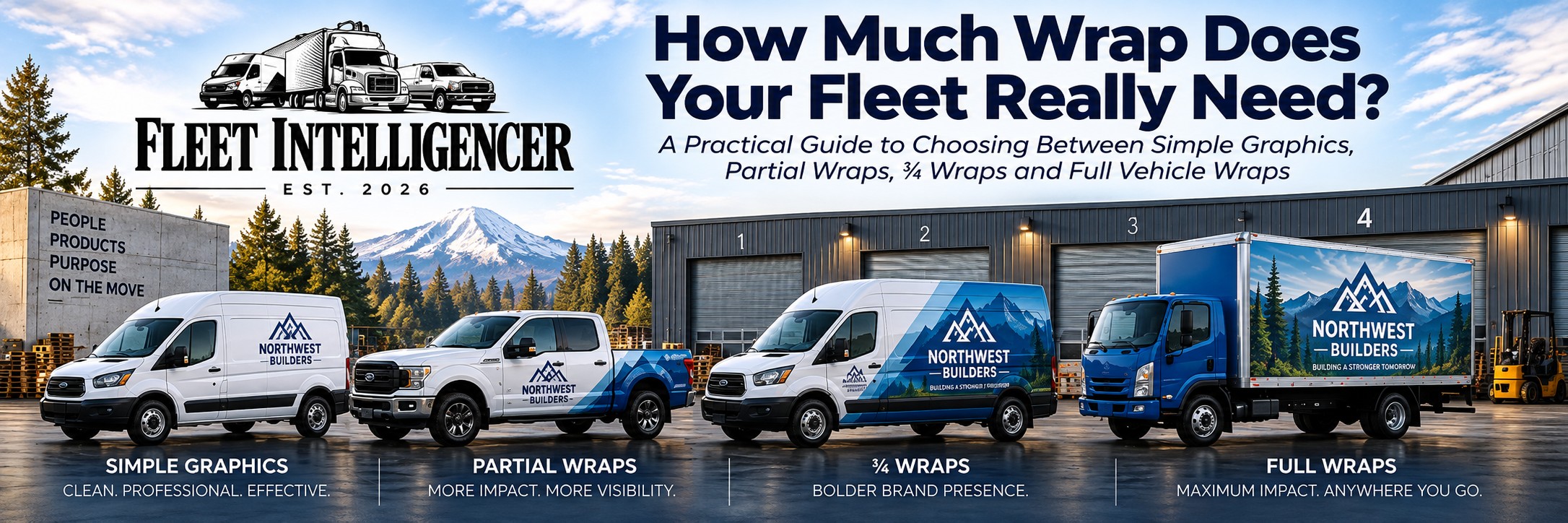
That is why deciding between simple graphics, a partial wrap, a ¾ wrap or a full wrap should begin with the business objective rather than the amount of vinyl being purchased.
Option One: Sometimes Simple Graphics Are Exactly Enough
There is nothing inherently basic about a well-designed graphics package.
Printed logos combined with plotter-cut lettering can provide a remarkably clean and professional appearance, particularly when the factory vehicle color already complements the company's brand.
A white van, for example, provides an enormous blank canvas. If white is already part of the company's visual identity, covering most of that perfectly usable surface with printed vinyl may provide little additional benefit.
Strategically positioned logos, brand colors, a website, phone number and concise description of services may be all that is necessary.
Simple graphics can be especially attractive for very large fleets, fleets with relatively short vehicle replacement cycles, leased vehicles or companies adding vehicles rapidly. They are typically easier to reproduce across different vehicle models and can make repairing or replacing individual graphics relatively straightforward.
The key word, however, is designed.
Simple graphics should not mean sticking a logo on a door and filling every remaining space with phone numbers, service lists and social media icons. Good fleet branding still requires hierarchy, proportion, readability and consistency.
Sometimes using less vinyl actually requires more design discipline.
Option Two: The Partial Wrap
A partial wrap begins to transform the vehicle itself into part of the company's visual identity.
Rather than covering every painted surface, a designer strategically combines printed graphics with the vehicle's original paint color. Done properly, it should be difficult for the casual observer to determine where the design ends and the factory vehicle begins.
This can provide much of the visual impact associated with a full wrap while reducing the amount of material and installation labor involved.
The important consideration is whether the vehicle's factory color can become an intentional part of the design.
A black vehicle might work beautifully with a company's branding. So might white, silver or another carefully selected fleet color. If vehicles are being ordered specifically for the company, choosing the right factory paint color can become part of the graphics strategy itself.
For growing fleets, this can be particularly valuable. Instead of treating the vehicle purchase and graphics package as unrelated decisions, the fleet manager can begin specifying vehicle colors that reduce the amount of coverage necessary to achieve the desired appearance.
That can create savings on every vehicle added thereafter.
Option Three: The ¾ Wrap
For many commercial fleets, the ¾ wrap occupies an interesting middle ground.
It provides enough coverage to dramatically transform the appearance of the vehicle without necessarily wrapping every available surface.
A design might leave the hood in factory paint. It might incorporate the original color into the front fenders or roof. It may transition deliberately from printed graphics into exposed paint rather than wrapping the vehicle from bumper to bumper.
When executed well, a ¾ wrap can deliver much of the visual presence of a full wrap while controlling production and installation costs.
This can be particularly effective on vans and larger commercial vehicles where the sides and rear provide the majority of the useful advertising space anyway.
The objective should never be to make the vehicle look like the company stopped wrapping it three-quarters of the way through.
The exposed paint should look like it was always intended to be part of the design.
Option Four: The Full Wrap
There are also situations where a full wrap simply makes the most sense.
A full wrap gives the designer maximum control over the appearance of the vehicle. The factory color becomes largely irrelevant, allowing the vehicle to be transformed into a consistent representation of the company's brand.
For businesses that rely heavily on their vehicles for advertising and brand recognition, that additional creative freedom can be valuable.
Full wraps also make it easier to create consistency across vehicles purchased in different factory colors, although standardizing vehicle colors at acquisition is generally preferable when possible.
But the decision to fully wrap a vehicle should still be based on business value rather than the assumption that more coverage automatically means better advertising.
A poorly designed full wrap can be less effective than a brilliantly designed partial wrap.
Square footage of vinyl is not a measurement of advertising effectiveness.
Recognition is.
Don't Budget for One Vehicle. Budget for the Fleet.
This is where the conversation becomes considerably more important for a fleet manager.
Imagine a company operating five vehicles today.
A premium graphics package costing several thousand dollars per vehicle may seem entirely reasonable. But what happens when the business grows to 15 vehicles? Or 25? Or 50?
Suddenly the graphics decision made for the first few vehicles has become a significant capital commitment.
This is why a fleet graphics program should be designed around the fleet the company expects to operate—not simply the vehicle sitting in the parking lot today.
A growing business should ask some basic long-term questions.
How many vehicles are likely to be added over the next three to five years? How long will each vehicle remain in service? Will the fleet consist primarily of one vehicle platform, or will it include vans, pickups, SUVs, box trucks and specialty vehicles? How frequently does the company update its branding? How likely are individual panels to require replacement because of collision damage or body repairs?
Those answers can significantly change what represents a sensible graphics investment.
Think in Cost Per Month, Not Just Cost Per Wrap
One useful way to evaluate fleet graphics is to amortize the investment over the expected service life of the vehicle.
Consider a hypothetical graphics package costing $5,400 on a vehicle expected to remain in service for six years.
Ignoring repairs or replacement graphics for the moment, that branding investment represents approximately $75 per month over the vehicle's expected service life.
A $2,400 graphics package over the same six years represents roughly $33 per month.
The actual decision, therefore, isn't necessarily whether the company should spend $2,400 or $5,400.
It is whether the additional branding impact of the more extensive package is worth approximately $42 per month for that vehicle.
For some businesses, the answer will clearly be yes.
For others, it won't.
Now multiply that decision across 20, 50 or 100 vehicles and the importance of having a deliberate fleet graphics strategy becomes obvious.
This is also why simply requesting a “price per wrap” doesn't always provide a fleet manager with the information needed to make the best decision.
The lowest initial price and the lowest long-term cost are not necessarily the same thing.
Remember the Costs That Come Later
The original installation is only part of the lifecycle of fleet graphics.
Vehicles get damaged. Doors get replaced. Quarter panels get repaired. Employees back into things. Brand standards change. Phone numbers change. Companies add services. Businesses merge or acquire other businesses.
Eventually, vehicles are also sold or returned.
A good fleet graphics program anticipates those realities.
Can an individual panel be reproduced three years from now? Are the original production files being maintained? Are colors and materials documented? Can a damaged door graphic be replaced without recreating the entire side of the vehicle? How difficult will the graphics be to remove when the asset reaches the end of its fleet life?
These aren't particularly exciting questions when the first vehicle is being designed.
They become very important when vehicle number 37 needs a replacement passenger door three years later.
Your Vehicles Don't All Have to Match. Your Brand Does.
Another common mistake is assuming every vehicle in the fleet requires exactly the same type of graphics.
Most fleets don't consist of identical vehicles.
A service company might operate Transit vans, F-150 pickups, small SUVs and several box trucks.
There is no rule saying each one must receive the same percentage of vinyl coverage.
The Transit might receive a ¾ wrap. The F-150 might work better with a partial wrap. The supervisor's SUV may only need carefully designed printed and plotted graphics. Meanwhile, the enormous sides of a box truck may justify extensive printed coverage because they provide such valuable advertising real estate.
The vehicles don't need to be identical.
They need to be unmistakably related.
Colors, typography, logos, graphic elements and messaging can create a recognizable fleet identity across dramatically different vehicle platforms.
That is the difference between designing individual vehicle wraps and developing a fleet branding system.
Design for Vehicle Number 50 While You're Wrapping Vehicle Number One
Perhaps the best advice for a growing company is to think several years ahead.
The first vehicle is where the creative work happens.
The vehicles that follow should become increasingly easier.
Once the brand system has been established, vehicle templates, colors, materials, production files, logo placement and design standards can all be documented.
When another vehicle is acquired, the question should no longer be, “What should we do with this one?”
Instead, it becomes, “How does this vehicle fit into the system we've already created?”
That saves design time, reduces approval cycles, improves brand consistency and makes budgeting substantially easier.
Ideally, the 20th vehicle should be easier to add to the fleet than the first.
So, How Much Wrap Does Your Fleet Really Need?
There isn't a universal answer.
And there shouldn't be.
For one company, professionally designed printed and plotted graphics may provide everything the business needs at an extremely efficient cost.
For another, a partial wrap may offer the perfect balance between visual impact and long-term scalability.
A ¾ wrap may give another fleet almost everything it wants from a full wrap without covering surfaces that contribute relatively little advertising value.
And for a business whose vehicles are among its most visible marketing assets, a complete wrap may easily justify the additional investment.
The objective shouldn't be to determine how much vinyl you can put on a vehicle.
It should be to determine how effectively that vehicle can represent your company for the amount you're prepared to invest in it over its useful life.
That's an important distinction.
A $2,000 graphics package can sometimes be a much smarter business decision than a $6,000 wrap. In another situation, spending the additional $4,000 may be one of the most cost-effective marketing investments that company makes.
An experienced fleet graphics provider should be willing to explain the difference.
At FLEETWRAPS.ai, powered by WrapJax, we believe the conversation should begin with the fleet rather than the wrap. Vehicle mix, expected growth, service life, brand objectives, operating environment and long-term budget should all help determine the graphics solution.
Because ultimately, the best fleet graphics program isn't the one that uses the most material.
It's the one your customers remember—and your business can realistically maintain as the fleet grows.
Was this article helpful?