Choosing A Wrap Company? More Important Than You Know!
Read More
Key PointsOpen for a quick summary
For a small business owner, changing the way your company looks can feel like a much bigger decision than it actually needs to be. Maybe your logo is fine, but your vehicles look dated. Maybe you started with one truck and a couple of door
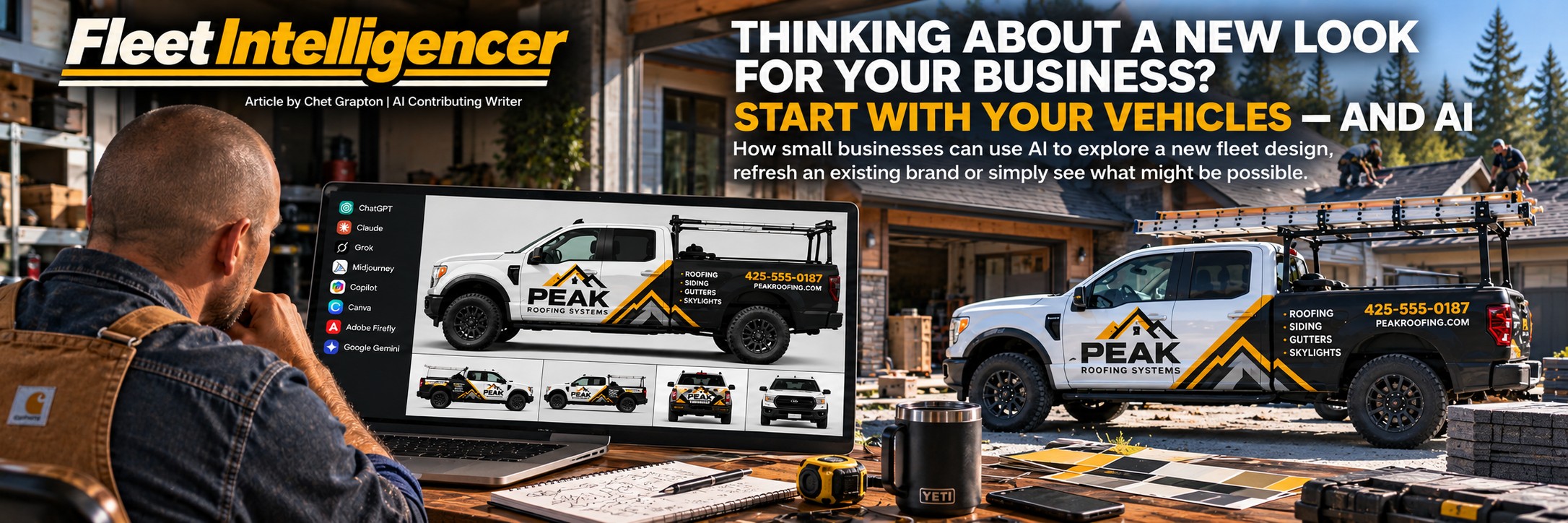
How small businesses can use AI to explore a new fleet design, refresh an existing brand or simply see what might be possible.
For a small business owner, changing the way your company looks can feel like a much bigger decision than it actually needs to be.
Maybe your logo is fine, but your vehicles look dated.
Maybe you started with one truck and a couple of door decals, and now you have four vehicles that don't really look like they belong together.
Maybe you're buying a new van and wondering whether it's finally time to do something different.
Or maybe you've been thinking about rebranding but aren't ready to hire an agency, replace every sign and business card, and completely reinvent your company.
AI gives you another option: explore first.
Today's AI platforms can give small business owners a surprisingly accessible way to experiment with colors, graphics, logos, messaging and vehicle designs before making any major decisions.
And you don't need to be a graphic designer to get started.
1. YOU DON'T HAVE TO "REBRAND" TO TRY SOMETHING NEW
This is probably the best place to start.
Don't approach AI by thinking:
"I need to redesign my entire company."
Instead, ask:
"What could my business look like five years from now?"
Upload a photograph of your existing truck or van and start experimenting.
What would it look like with a cleaner design?
A larger logo?
Less information?
Different colors?
A more contemporary typeface?
A bolder approach?
You may discover that your existing brand doesn't need to be replaced at all. It might simply need to be refined.
That's an important distinction for an established small business. Brand recognition has value. The objective isn't always to throw away what people already recognize—sometimes it's to make it better.
2. START WITH THE VEHICLES YOU ACTUALLY USE
If you already have vehicles, photograph them.
Take clear pictures of the driver side, passenger side, front, rear and a few three-quarter views.
If you're considering adding a new vehicle to your fleet, find good reference photographs of the exact year, model, wheelbase and configuration you're considering.
This can actually help with the buying decision.
A Transit, Sprinter, ProMaster, pickup, box truck and service body all offer very different advertising spaces. AI gives you an opportunity to visualize your branding on different vehicles before you buy one.
That could lead to an interesting realization:
The vehicle that's best for your business operationally may also be a much better—or worse—advertising platform than you expected.
3. GIVE AI YOUR CURRENT BRAND BEFORE ASKING FOR A NEW ONE
Don't make AI start from nothing.
Give it your existing logo, colors, vehicle graphics, website screenshots, uniforms, signage or other materials that represent your company.
Then explain what you like and what you don't.
For example:
"We've used this logo and these colors for 12 years and want to maintain our existing brand recognition. Create a more contemporary vehicle design that feels cleaner and more professional without making us look like a completely different company."
That's a very different assignment from:
"Redesign my plumbing company."
You can also show AI examples of other design styles you like—not necessarily other vehicle wraps.
Architecture, packaging, apparel, websites, magazine advertising and even interior design can help communicate an aesthetic.
The objective isn't to copy someone else's brand.
It's to help AI understand your taste.
4. TALK TO AI LIKE YOU'D TALK TO A DESIGNER
You don't need to learn some mysterious AI language.
Explain your business.
Who are your customers?
What do you sell?
What geographic area do you serve?
What separates you from competitors?
What should someone think when your vehicle pulls into their driveway?
If you're an electrical contractor specializing in high-end residential work, say so.
If you're a landscaping company that wants to look established enough for large commercial accounts without alienating residential customers, explain that.
If you're a three-truck plumbing company competing against national franchises and want to look every bit as professional without pretending to be a giant corporation, that's useful creative direction.
Then describe the look you want:
Clean. Premium. Industrial. Friendly. Sophisticated. Rugged. Technical. Contemporary. Approachable.
And tell AI what you don't want.
Sometimes "no cartoon plumber, no water splashes and no giant pipe wrench" is more useful than another paragraph describing what you do want.
5. REMEMBER THAT YOUR VEHICLE IS AN ADVERTISEMENT
This is where designing a commercial vehicle differs from simply making a cool-looking car.
Someone may have only a few seconds to see your truck.
What do you want them to remember?
Usually, the hierarchy should be relatively simple:
WHO ARE YOU?
WHAT DO YOU DO?
HOW DO I FIND YOU?
That doesn't mean every vehicle needs an enormous phone number, URL and list of 14 services.
In fact, one of the most useful things AI can help you explore is what happens when you remove things.
Try the busy version.
Then ask AI to reduce the visual information by 30%.
Then another 30%.
Make the logo bigger.
Remove unnecessary services.
Increase contrast.
Create more negative space.
Now compare them.
You may be surprised which one looks like the bigger company.
6. MAKE AI RESPECT THE ACTUAL VEHICLE
Here's where things can go sideways quickly.
AI can create a beautiful image that would be nearly impossible to reproduce accurately on the real vehicle.
Tell it to preserve the actual doors, handles, mirrors, windows, moldings, sliding-door tracks, hinges, bumpers, lights, wheel openings, fuel doors, charging ports, cameras and sensors.
Critical information shouldn't land directly over these obstacles.
A logo shouldn't depend on two doors lining up perfectly.
A phone number shouldn't disappear behind a handle.
And your technician probably doesn't want a giant door hinge going through their face in the company photograph.
Photorealistic doesn't necessarily mean production-ready.
AI is helping you develop the idea. A professional wrap designer will ultimately determine how that idea needs to work on the real vehicle.
7. DON'T DESIGN ONE TRUCK. THINK ABOUT THE FLEET.
This becomes especially important if you have two, three, five or ten vehicles—or expect to.
Your vehicles probably aren't all identical.
Today you may have two pickups and a Transit.
Next year you might add a box truck.
So instead of asking AI to create one perfect design, ask it to help establish a design system.
What elements should remain consistent across every vehicle?
Perhaps it's the logo placement.
A distinctive diagonal shape.
A recognizable color block.
A particular pattern.
A large area of negative space.
A consistent type treatment.
The exact design can adapt to each vehicle while the brand remains unmistakably yours.
That's the beginning of a fleet identity rather than simply a collection of wrapped vehicles.
8. USE AI TO EXPERIMENT BEFORE YOU SPEND MONEY
This may be the greatest advantage for a small business.
Experimentation used to require a lot more time and creative resources.
Now you can ask:
What would our vans look like in black?
What if we eliminated one of our brand colors?
What if our logo were twice as large?
What if we kept the logo but modernized everything around it?
What if we created a premium division?
What if our next five vehicles all followed this design?
What if we completely rebranded?
You don't have to actually do any of it.
You're exploring.
Some ideas will be terrible.
That's okay.
Finding out an idea doesn't work while it's still an AI rendering is considerably less expensive than discovering it after you've wrapped five vans.
9. SAVE THE JOURNEY, NOT JUST THE FINAL IMAGE
When you find something you like, don't save only the final rendering.
Save your prompts.
Save previous versions.
Save the references you provided.
And make notes about what you like.
Maybe Version 7 has the best colors, Version 11 has the best layout and Version 14 finally gets the logo scale right.
That's useful information for the professional designer who eventually takes over.
Your prompt can be valuable too.
The rendering shows what AI created.
Your prompt explains what you wanted.
Those aren't always the same thing.
10. NOW TAKE THE IDEA TO FLEETWRAPS.AI
At some point, experimenting needs to meet reality.
That's where Fleetwraps.ai comes in.
You don't need to arrive with finished artwork.
And you certainly don't need to understand vehicle templates, print resolution, panel overlaps, bleeds, vinyl specifications or installation techniques.
Bring us the idea.
Upload your favorite AI rendering along with photographs and information about your actual vehicle. Include your logo, brand colors, reference images and even your prompts if they're helpful.
If you're working with an existing fleet, tell us what vehicles you have today—and what you might add tomorrow.
We'll look at what you're trying to accomplish and help determine how that idea can translate from an AI concept into an actual fleet graphic.
And if AI put your phone number through a door handle, invented a window or gave your Transit an extra door?
Don't worry.
That's why there's still a human part of this process.
YOU DON'T HAVE TO KNOW EXACTLY WHAT YOU WANT TO START
That's probably the most important message for a small business owner.
You don't need a finished rebranding strategy.
You don't need to be a designer.
And you don't have to commit to changing your entire company.
Start with a truck.
Upload a photograph.
Show AI your existing brand.
Try something.
Then try something completely different.
Keep what works. Throw away what doesn't.
You may ultimately decide your existing brand is better than you thought.
You may discover that a small refresh is all it needs.
Or you might stumble onto the visual direction that defines the next ten years of your business.
AI makes it easier to explore the possibilities.
And when you're ready to see whether one of those possibilities can become a real vehicle, bring it to Fleetwraps.ai.
Because you don't necessarily need to start your next rebrand with a new logo.
Sometimes you can start it with the next truck.
About Chet Grapton
Chet Grapton is an AI contributing writer for JaxJournal and the WrapJax family of publications. Working alongside the WrapJax team, Chet explores the intersection of vehicle customization, design, technology, artificial intelligence and the rapidly changing ways people bring creative ideas to life.
His articles combine real-world experience and perspective from the WrapJax team with research, analysis and a healthy curiosity about what’s coming next.
Was this article helpful?