Choosing A Wrap Company? More Important Than You Know!
Read More
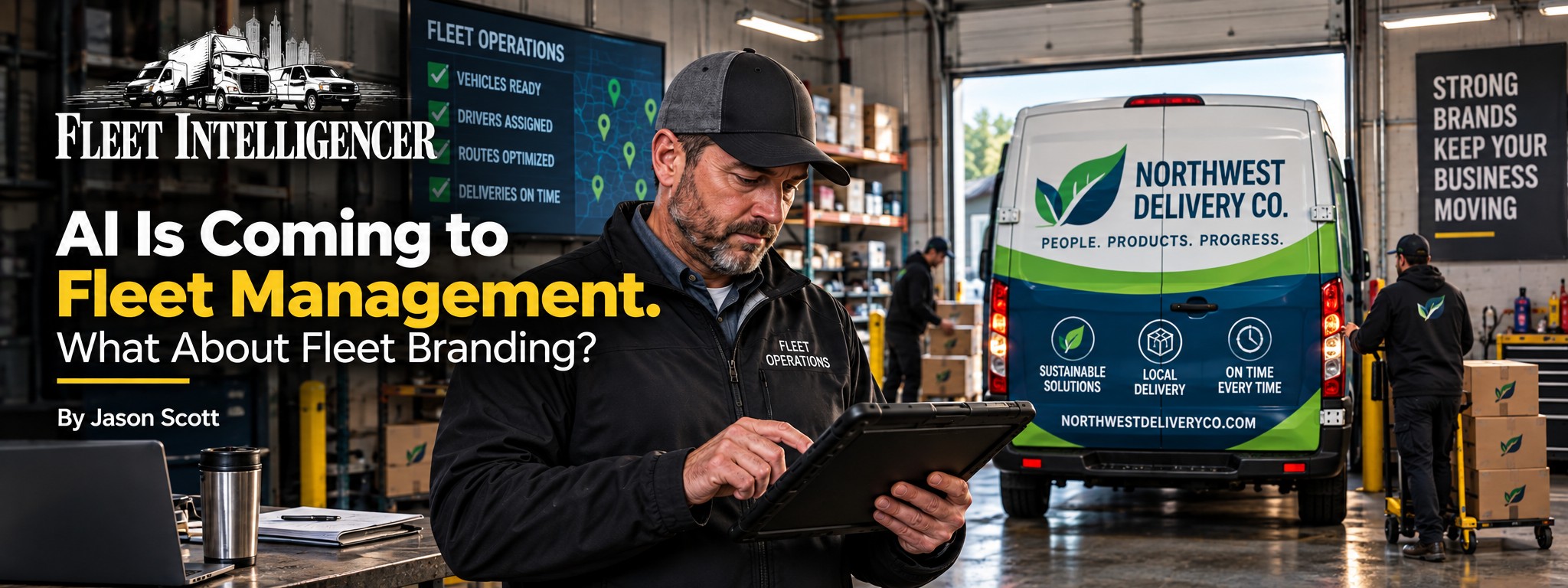
Fleet Managers Are Using Artificial Intelligence to Make Better Decisions. Maybe It's Time We Talk About What It Can Do for the Vehicles Everyone Else Sees. Fleet Intelligencer If you manage a…
Fleet Managers Are Using Artificial Intelligence to Make Better Decisions. Maybe It's Time We Talk About What It Can Do for the Vehicles Everyone Else Sees.
Fleet Intelligencer
If you manage a fleet today, there's a pretty good chance artificial intelligence has already entered the conversation somewhere.
It may be helping analyze telematics data, identify risky driving behavior, anticipate maintenance needs or make sense of information that once required someone to spend hours working through spreadsheets and reports. The applications are expanding quickly enough that the question for many fleet departments is no longer whether AI will become part of fleet management, but where it actually provides enough value to justify using it.
The numbers tell an interesting story. Fleetio's 2026 Fleet Benchmarking Report, which includes feedback from more than 600 fleet professionals, found that 53.3% of respondents are researching or piloting AI capabilities, while only 5.6% report using AI broadly today. Half of respondents identified accuracy and reliability as their primary hesitation about adoption.
That's probably a pretty healthy attitude. AI is useful, but it isn't magic.
While the fleet industry is understandably concentrating on AI for safety, maintenance, routing, operating costs and vehicle utilization, there is another part of fleet operations that receives considerably less attention: what happens between acquiring a vehicle and getting a properly branded, fully upfitted vehicle into service.
We think of that process as Fleet Wrap Logistics, and it's an area where AI could become surprisingly useful.
The Fleet Is Getting Smarter
The modern fleet vehicle has essentially become a rolling source of data. Location, mileage, fuel consumption, engine diagnostics, maintenance history and driver behavior can all become part of a much larger operational picture.
Verizon Connect's 2026 Fleet Technology Trends Report, based on responses from almost 900 fleet professionals, found that 80% now use GPS fleet tracking technology. Video telematics adoption has reached 46%, and 74% of those users said the technology helped improve driver safety.
Geotab, meanwhile, reports that its 2026 State of Commercial Transportation analysis draws from nearly six million connected vehicle subscriptions generating approximately 100 billion data points every day.
We've become extraordinarily sophisticated about understanding what a fleet vehicle is doing mechanically and operationally. We know where it is, how it's being driven and increasingly when it may need attention before a problem takes it out of service.
Yet when a new vehicle arrives and it's time to put the company's identity on the outside of it, many organizations are still following essentially the same process they were using fifteen years ago. Someone emails a logo to a graphics company, somebody finds a photograph of an older truck and the instruction becomes something along the lines of, "Can you make the new one look like this?"
There may be a better way.
AI Can Help Us Visualize the Fleet Before We Build It
One of the most useful applications of generative AI in fleet branding isn't replacing a graphic designer. It's helping people see possibilities much earlier in the process.
Suppose a company has operated Ford Transit vans for the last decade and is adding a completely different vehicle platform. Maybe it's an electric delivery van, a pickup, a compact service vehicle or simply a new body configuration the company has never owned before.
The existing graphics package may not translate particularly well. A logo that looked perfectly proportioned on a Transit may suddenly look lost on the side of a pickup, while a graphic that flowed beautifully through the body lines of one van may intersect a charging port, door handle, camera or sensor on another.
Historically, exploring multiple alternatives required a designer to manually create every concept someone wanted to consider. AI can change the front end of that conversation by allowing a fleet manager, marketing department and graphics provider to explore different approaches before significant time is invested developing final production artwork.
We can ask what the established brand might look like on a different body style, experiment with the scale and placement of branding elements or consider whether a graphics program developed years ago could benefit from a refresh.
That doesn't make the AI rendering production-ready.
It makes the conversation better.
There's a Big Difference Between Visualization and Production
This distinction matters, particularly for commercial fleets.
An AI-generated image might create a beautiful service van, but AI isn't necessarily concerned with whether the vehicle shown actually exists in that configuration. It isn't thinking about sliding-door tracks, panel overlaps, body seams, DOT markings, emergency equipment, window perforation or whether an important graphic is going to disappear behind a door handle.
It may also decide your company's logo needs "improvement," which is generally not something your marketing department will appreciate.
An AI-generated fleet concept should therefore be treated as exactly that: a concept. Once a direction has been established, a professional designer still needs to work with accurate vehicle templates and actual brand assets. Logos need to remain logos, corporate colors need to remain consistent, phone numbers and URLs need to be correct, and graphics have to be positioned around the real vehicle rather than the imaginary one AI happened to create.
For one vehicle, those details matter. Across 50 vehicles, they become a brand standard.
This Is Where Fleet Wrap Logistics Enters the Picture
Fleet branding isn't simply a design and installation problem. For a fleet manager, it's a logistics problem as well.
A new commercial vehicle may pass through a dealership, equipment upfitter, graphics provider and possibly several other vendors before it ever reaches the employee who will drive it. Every additional handoff creates another schedule to coordinate, and every unnecessary day between delivery and deployment represents an asset the company owns but isn't fully utilizing.
That's what we mean when we talk about Fleet Wrap Logistics.
It's the coordination of vehicle acquisition, graphics planning, design approval, production, upfitting, installation and final deployment so that branding doesn't become an afterthought at the end of the process.
For a company adding one truck, that may be fairly straightforward. For an organization receiving 20 vans in three different configurations across several locations, it becomes something else entirely.
Now we're talking about VINs, vehicle assignments, approved graphics packages, production schedules, installation capacity, upfit sequencing, delivery dates and knowing which vehicle needs to be where—and when.
AI has the potential to help organize and accelerate parts of that process, particularly as the number of vehicles and variables increases.
Where AI Could Become Really Valuable Is Consistency
Fleet branding rarely happens all at once. Vehicles are acquired over years, models change, manufacturers redesign bodies, companies merge or acquire other businesses, logos get updated and new services are added. One graphics vendor may eventually be replaced by another.
Before long, what started as a consistent fleet can become a rolling history of every branding decision the company has made over the last ten years.
AI won't solve that problem by itself, but it can become another tool for identifying and visualizing inconsistencies.
Imagine having a clearly established fleet graphics standard containing approved logos, colors, typography, graphic placement, material specifications and production requirements. When a new vehicle class is being considered, AI can help visualize how those established standards might translate before the vehicle is even delivered.
The important part isn't asking AI to reinvent the brand every time another van arrives. It's almost the opposite.
Use technology to help preserve the brand while the fleet changes around it.
That same principle can extend into Fleet Wrap Logistics. Once graphics packages have been established for particular vehicle configurations, they can become part of a repeatable process rather than another custom project that has to be reinvented every time a new vehicle enters the fleet.
AI Can Help Bridge the Gap Between Fleet and Marketing
Anyone who has managed a significant fleet knows that the people responsible for the vehicles and the people responsible for the brand aren't always sitting in the same department.
Fleet may be focused on acquisition cost, uptime, maintenance and getting a new vehicle into service as quickly as possible. Marketing cares about logo standards, colors, messaging and how the company presents itself publicly.
Both are right.
The vehicle has to work, but it also represents the company every time it leaves the parking lot.
AI visualization can give those departments a common starting point. Instead of reviewing abstract descriptions or trying to imagine how artwork from an older vehicle will translate onto a new one, stakeholders can evaluate concepts visually much earlier.
Marketing can say, "The logo needs more presence." Fleet can point out that a particular area contains an equipment compartment. Operations may need a window unobstructed, while the graphics professional may recognize that a proposed element crosses a body feature that will make installation unnecessarily difficult.
Those conversations can happen before the vehicle is sitting somewhere waiting for everyone to make a decision.
And that's not just better design.
That's better Fleet Wrap Logistics.
The Bigger Opportunity May Be Speed
Fleet managers don't generally have the luxury of treating every vehicle like a six-month creative project. When vehicles arrive, the objective is usually to get them equipped, branded and earning their keep.
That's particularly important in 2026, when cost control has become such a dominant concern. Element Fleet Management's 2026 Market Pulse Report found that 78% of North American fleet leaders identified cost savings as a priority, while 49% cited vehicle downtime management as a priority.
In that environment, every unnecessary step matters.
If AI can help a fleet manager and graphics provider narrow ten possible creative directions down to two before a designer begins building final artwork, that's useful. If it helps stakeholders approve the overall appearance of a new vehicle class before the first vehicle arrives, that's useful too.
But there's an even larger opportunity when that technology is combined with a coordinated logistics process.
Imagine knowing the graphics requirements while vehicles are still being acquired, having the artwork approved while they're being upfitted and scheduling installation before they arrive at the graphics facility. Instead of the wrap becoming another task added after everything else is completed, it becomes part of the vehicle's deployment plan from the beginning.
The objective isn't simply to eliminate people from the process.
It's to eliminate waiting from the process.
There's Another Side of AI That Fleet Managers Should Be Cautious About
AI makes creating things incredibly easy, and that can also become a problem.
If every branch manager, marketing employee or regional office can generate a different version of what they think the company's fleet should look like, AI could actually make brand inconsistency worse rather than better.
A national or regional fleet doesn't need 37 creative interpretations of its identity. It needs a system.
That means there still needs to be an approved graphics standard, a central source for current artwork and someone with the authority to decide what represents the company. AI should operate within those standards rather than becoming an excuse to bypass them.
There's also the basic issue of accuracy. Fleetio found that half of surveyed fleet professionals cited accuracy and reliability concerns as their biggest hesitation about AI adoption, and those concerns apply to creative AI as well.
Anyone who has spent enough time generating images has seen AI confidently produce a nonexistent vehicle model, invent a logo, misspell a company name or place six lug nuts on a five-lug wheel. It's impressive technology, but it still needs supervision.
Human Intelligence Is Still Part of the Equation
One of the better observations I've seen about AI and fleet management came from Brian Bathe and Sarah Richey, writing for Automotive Fleet. Their argument was essentially that the real breakthrough isn't artificial intelligence operating by itself, but combining new technology with something that can't be automated: hard-earned human experience and strategic judgment.
That idea translates perfectly to fleet graphics and Fleet Wrap Logistics.
AI doesn't know that a particular vinyl may not be appropriate for a certain surface. It doesn't know that graphics wrapping deeply into a particular body contour could create an installation problem several years from now, nor does it necessarily understand why a logo should move six inches forward because a ladder rack will obscure it once the vehicle is upfitted.
It also doesn't know that three vans scheduled to arrive Tuesday have been delayed at the upfitter while another four vehicles have suddenly become available for installation Thursday afternoon.
Those are real-world decisions, and an experienced fleet graphics provider understands how design, production, installation and scheduling affect one another.
The most productive future probably isn't AI versus people. It's people who understand their business using AI to make better decisions.
What Could an AI-Assisted Fleet Wrap Logistics Process Actually Look Like?
It might begin much earlier than fleet graphics traditionally have.
When a company is considering a new vehicle, the graphics provider could receive the year, make, model and configuration before the vehicle ever arrives. Existing brand standards and graphics could be reviewed while AI visualization helps explore how the established identity might translate onto the new platform.
Fleet and marketing teams could evaluate those concepts and establish a direction before final production artwork is created. A professional designer would then adapt the approved concept to an accurate vehicle template, verify all branding and required information, prepare production files and establish the specifications necessary to reproduce those graphics consistently.
Meanwhile, installation becomes part of the deployment schedule rather than something arranged after the vehicle appears in the parking lot.
Acquisition → Upfitting → Graphics → Installation → Deployment.
The objective of Fleet Wrap Logistics is to make those stages work together instead of treating each one as an unrelated transaction.
Once a particular vehicle configuration has been successfully completed, its approved artwork, specifications and production information become part of the company's graphics library. When another identical vehicle enters the fleet six months later, everyone doesn't need to start from the beginning.
We already know what we're doing.
That's where AI becomes much more interesting than simply generating cool pictures of vans.
It becomes part of a repeatable process.
Fleet Branding Should Be Getting Smarter Too
AI is already finding its place inside fleet operations. It's helping analyze vehicle data, improve safety, identify maintenance needs and make increasingly complex fleets easier to understand.
The technology is still early. Fleetio's numbers make that clear: more than half of fleet professionals may be researching or piloting AI, but widespread implementation remains relatively uncommon.
That's probably exactly where fleet branding is today as well.
We shouldn't use AI simply because it's new, and we certainly shouldn't hand over the keys to the brand and let an algorithm decide what the fleet should look like. But we also shouldn't ignore what these tools can do when they're combined with experienced people and a well-organized process.
Used intelligently, AI can help fleet managers visualize new vehicles sooner, explore ideas faster, communicate more effectively with marketing departments and graphics providers, and create a more efficient path from vehicle acquisition to a finished, branded asset that's ready to go to work.
At FLEETWRAPS.ai, we think of that larger process as Fleet Wrap Logistics.
It's not simply about putting graphics on vehicles. It's about understanding where graphics fit within the acquisition, upfitting and deployment process and finding ways to make that process more predictable, repeatable and efficient.
AI gives us another tool for doing that.
Not replacing the fleet manager. Not replacing the designer. Not replacing the production team or installer.
Connecting them earlier, giving them better information and helping move vehicles through the process more intelligently.
Because if we're going to make the inside of the fleet smarter, it probably makes sense to start thinking a little smarter about the outside of it too.
Was this article helpful?